

The Bone Betrayal
Why drugs, exercise and supplements are failing us, and a new path forward to an unbreakable body.
By Kyle Zagrodzky, founder and CEO of OsteoStrong, and Dr. Jimmy Youngblood, OsteoStrong's president. Foreword by Tony Robbins.
Copies are coming to our studio in the next few weeks.
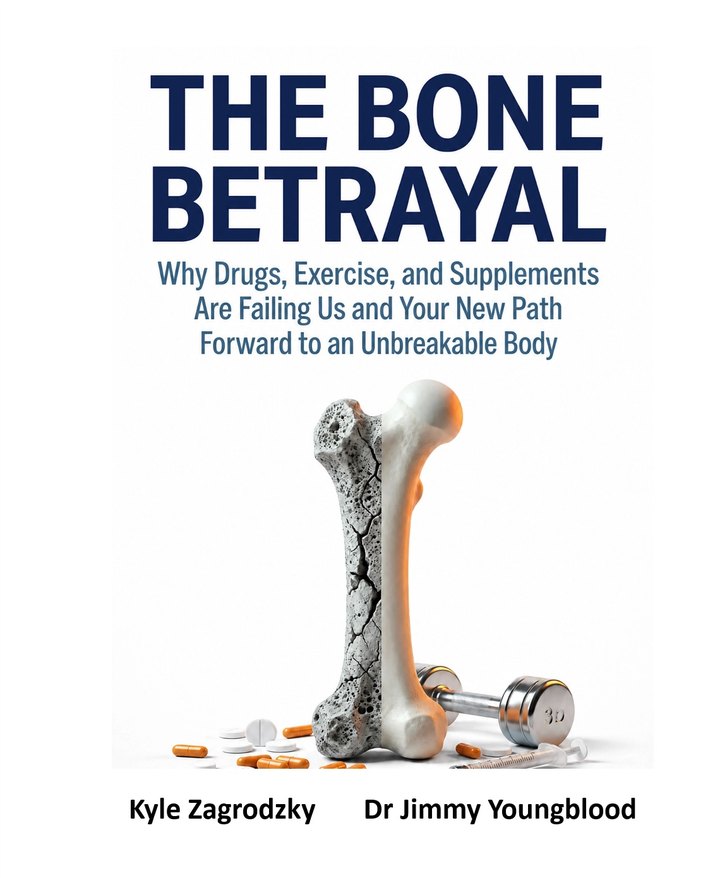
A broken bone isn't where the story starts.
The book's case is that fragility builds quietly for decades. It starts in childhood, with how much bone we build while we're growing. It continues through a modern life that asks our skeletons to carry less and less force. And it's often noticed only after something breaks.
Long before a fracture, a weaker frame shrinks a life. People lose confidence first, then movement, then independence. The authors argue the problem is bigger than an osteoporosis diagnosis, and that bone deserves attention as a living organ, not just a number on a scan.
It's the same thing we tell people every week at the studio: bone responds to what you ask of it.
A prescription. A supplement. A gym membership.
These are the three answers most people get. The book doesn't call any of them useless. It asks where each one's promise runs ahead of the evidence, or ahead of what it actually delivers to the people who need it.
Medication
Weighed on fracture benefits, long-term tradeoffs and rare harms, and on a key distinction: slowing bone loss isn't the same as building new bone.
Supplements
More than "take calcium." Nutrient forms, how nutrients depend on each other, labeling, and what the studies actually measured. Bone is a matrix, not only mineral.
Exercise
The authors defend loading as the principle. Their question is whether the usual gym model, with its cost, equipment and intimidation, reaches the people who need it most.
The science of osteogenic loading.
Chapter 15, and the reason OsteoStrong exists.
"Osteogenic" means bone-building. The book walks through what decides whether a load is enough to signal bone to adapt:
- Wolff's LawBone remodels to fit the loads placed on it.
- Frost's mechanostatBone gains above a strain threshold and loses below one, and the biggest loads come from your own muscles.
- Size beats repetitionHow much force matters more than how many times. Brief bouts can be enough, and the response levels off with more of the same.
- Every site is differentA load that's enough for the spine may not be enough for the hip, and the pelvis has rarely been studied directly.
- How bone hears forceOsteocytes, cells buried in the bone, sense fluid moving through their channels and help switch building on or off (Chapter 12).
That's the idea behind a session here: one brief, maximal, measured effort at each station, in a position where you're strong and nothing can fall on you. The book reviews supervised high-intensity trials and device-based research. As we say on our bone health page, trials of these exact machines are still thin, so we show you your own numbers every week.
Two people. One T-score. Two different skeletons.
A DXA scan gives you a density score, and the book says to keep getting them. But density alone doesn't tell you how strong a bone is. Two people can share a T-score and have very different structure inside: the plates and rods of spongy bone, pores in the outer shell, collagen quality, water content, shape, and accumulated micro-damage.
It also notes that a rising density number can mean existing bone got more mineralized, not that the same amount of new bone was built. Tools like trabecular bone score, turnover markers and advanced imaging fill in more of the picture. Ask your doctor which ones make sense for you.
Seventeen chapters, six parts.
The full argument, not a list of tips. It moves from the cost of fragility through childhood, environment and whole-body biology to measurement, loading and lifelong strength.
1 · The crisis
- A Crisis Hidden in Plain Sight
- The Architecture of a Crisis: How We Built a Fragile World
2 · Overlooked conditions
- The Elephant in the Laboratory
- The Skeleton They Never Built: Peak Bone Mass and the Generational Bone Crisis
- The Invisible Threat: Environmental Toxins, Endocrine Disruptors, and the Modern Skeleton
3 · Whole-body consequences
- The Age Acceleration Crisis
- The Gut-Bone Axis: Microbiome, Immunity, and Skeletal Integrity
- The Cellular Battleground: Senescence, Inflammation, and the Aging Skeleton
4 · Renewal and measurement
- The Process of Bone Remodeling
- The Three Pillars: A Critical Examination
- Beyond the Number: Bone Quality, Microarchitecture, and Why DXA Alone Is Not Enough
5 · Signals bone responds to
- The Language of Bone: How Your Skeleton Listens and Adapts
- The Bone-Brain Axis: How Your Skeleton Governs Cognition, Memory, and Mental Health
- The Circadian Skeleton: Time, Rhythm, and Bone Remodeling
- The Science of Osteogenic Loading
6 · A lifetime of strength
- The Skeleton Does Not Discriminate
- Bone as a Longevity Organ
Highlighted chapters are the ones closest to what we do at the studio.
You don't need a diagnosis to need this book.
It's written for a much wider group than people with osteoporosis.
About the book
When can I get a copy?
The publisher hasn't announced the release date, formats or price yet. We expect copies at the studio in the next few weeks, so ask at your next visit or call us. To hear the moment it's out, join the free launch list. It's not a preorder and costs nothing.
Is it only about osteoporosis?
No. Fractures and osteoporosis set the stakes, but it also covers childhood bone building, environmental toxins, hormones, the gut, the brain, sleep and daily rhythms, measurement, loading and longevity.
Does it say medication is useless?
No. It acknowledges real benefits and looks at limits and tradeoffs. Decisions about your medication stay with your doctor.
Is the book about OsteoStrong?
It's about bone science, written by OsteoStrong's founder and president. It isn't a sales brochure: the foreword calls it deeply researched, and the authors cite more than 400 papers.
Can I try what the book describes?
Yes. Your first session here is free. One measured effort at each of four stations, 10 minutes or less, once a week, in the clothes you have on. See what a first visit is like.
Don't wait for the book to start.
Your first session is free. Come feel what osteogenic loading is like and leave with your starting numbers.